
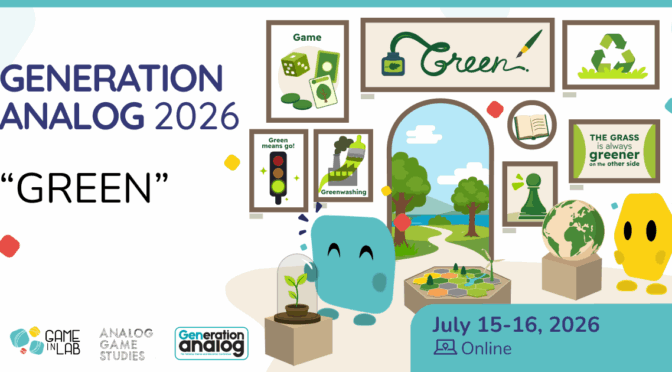
Analog Game Studies and Game in Lab are proud to announce Generation Analog 2026. This year’s conference will be on Wednesday & Thursday, July 15 & 16, 2026. The online event is free and open to the public with registration.
Registration is now open: https://www.eventbrite.com/e/generation-analog-2026-green-tickets-1989661215255! Online event link will be sent prior to conference dates. Session times are all Eastern Daylight Time (EDT)/GMT-4.
All presentations will be recorded and made available after the event. Check out the presentations from previous years via AGS’s YouTube channel (like and subscribe!): https://shorturl.at/asKQ9.
Generation Analog 2026 “GREEN” Schedule DRAFT
Wednesday, July 15, 2026 | All Times are EDT (GMT-4)
| Wednesday July 15, 2026 8:45-9:00 AM EDT |
Welcome & Opening Remarks | Edmond Chang (he/they), Megan Condis (she), Shelly Jones (they), Evan Torner (he), Aaron Trammell (he), Emma Walderon (she), Bea Livesey-Stephens (she), Analog Game Studies Editorial Board |
| SESSION 1A: GAMING GREEN Wednesday July 15, 2026 9:00-10:30 AM EDTModerator: Evan Torner |
How Green Is Green Play? Gamewashing in Analog Board Games
This presentation examines “gamewashing” in analog board games, analysing how ecological themes and sustainability claims may diverge from actual game mechanics and player experience. Drawing on greenwashing scholarship, it proposes a framework to assess the alignment between environmental rhetoric and ludic systems. |
Jérome Legrix-Pagès (he), University of Caen Normandy, Unicaen Gaming Lab |
| Green Narratives in Climate Change Board Games: Green Reformist, Green Radical, or Greenwashing?
This study applies critical discourse analysis to five commercial climate change board games to identify the dominant ‘green’ narratives. The findings reveal that most games reinforce ahistorical, problem-solving approaches rooted in existing economic systems, while arguing for board games’ untapped potential to foster deeper engagement with the colonial and capitalist roots of the climate crisis. |
Lynda Dunlop (she), University of York
Prasad Sandbhor (he), University of York |
|
| Plastic Dystopia: Ideas towards More Sustainable Miniaturing Practices
In this systemic review of sustainable hobby practises, the aim is to create a “battle plan” for embodied practises, potential changes to how we engage with different material aspects of the larger miniaturing hobby: painting, gaming, crafting, and collecting. The end product of this review is to propose new ways of engaging with the hobby within global miniaturing communities in order to minimize the ecological footprint of the hobby and rethink the ways miniaturing hobbies are engaged with. |
Aasa Timonen (she), Tampere University | |
| Gotta Financialize ‘Em All: Financialization, PokeInvesting, and Visual Media
Through an analysis of the subreddit r/PokeInvesting during the perceived ‘crash’ of Pokémon card value between October and November 2025, this paper shows how posts of finance memes and portfolio graphs from apps such as Collectr operate to visually financialize Pokémon cards through the nonspecificity of finance rhetoric, highlighting the ways in which game cultures can advance financialization. In understanding the inherently violent nature and history of finance, this paper argues for the necessity of paying critical attention to how finance rhetoric becomes subsumed into game spaces, highlighting the need to understand the relationship between games, game cultures, and financialization. |
Changie Chang (they), University of California, Irvine | |
| KEYNOTE I
Wednesday Moderator: Aaron Trammell |
“Between Cozy and Cutthroat: Finding Nature in Analog Games”
What does environmentally oriented scholarship on digital games have to offer the study and design of analog games, specifically in terms of their “greenness”? Do non-digital games occupy a privileged place in relation to matters of sustainability, natural aesthetics, or the representation of scientific processes? I hope to draw out commonalities as well as distinctions between these largely complementary realms, and offer some suggestions about how we might think about environmental analog games in the future. |
Alenda Y. Chang, Associate Professor, Film & Media Studies, University of California, Santa Barbara, Author of Playing Nature: Video Games and Ecology |
| SESSION 1B: GREEN PLAYERS
Wednesday Moderator: Bea Livesey-Stephens |
Staying “Green”: Newbie Identity, Face-Work, and Legitimate Peripheral Participation at the D&D Table
Taking that prompt seriously (if not playfully), this presentation reframes “the new player” in tabletop role-playing games as an identity position that is socially produced, managed, and sometimes stigmatized (rather than a temporary lack of rules knowledge). Drawing on qualitative analysis of textual accounts from a study of Dungeons & Dragons play (a survey of 198 participants with participants’ descriptions of first sessions, learning moments, and table dynamics), we examine how players narrate becoming – and ceasing to be – “green.” |
Chelsea Russell (she), University of Toronto Mississauga
Michael Nixon (he/his), University of Toronto Mississauga |
| Green Means Go: Applying Zero Sessions in Research and Academia
Students’ agency as adults; faculty hesitation to host controversial discussions; or non-gamers’ social-emotional growth are facilitated by zero sessions, cooperative games, role-playing, even self-selecting out of a research survey or playing a game. Participatory consent is a through line across research and academia: volunteering for a study, orienting students to a new course, scaffolding self-advocacy, self-awareness, and agency in offering consent, requesting consent, and critically analyzing whether and how to request, offer, or query levels of consent. |
Jennifer AW Stubbs (she), Bradley University
Catherine Bowers (she), Valdosta State University |
|
| From Role-Player to Nature Lover: Harnessing Immersion to Encourage Time Outdoors
There are many benefits to health and wellness that come from being in natural spaces, and new research suggests that engaging in nature-filled immersive art generates feelings of calm, purpose, and exploration. Could nature-focused TTRPGs, such as the upcoming therapeutic game Spiritkeep, harness immersion and ego bleed to encourage players to spend time outdoors? |
Luka Brave (he/they), Psychhound Games | |
| The Dead Man’s Hat: Objects and Agency in Larp
This presentation describes an ANT-based method for understanding objects in larps as actors within a network that includes the game, the players, the characters, and the narratives, and how the resulting perspective highlights an “interpenetration of self and the world of objects and events’.’ |
Jason Cox (he), University of Toledo | |
| SESSION 1C: GREEN ENVIRONMENTS
Wednesday Moderator: Shelly Jones (they) |
What is an Ecorevolutionary TTRPG?
The study examines a corpus of tabletop roleplaying games for themes of ecological resistance and revolution. The guiding question is: are there ‘ecorevolutionary’ TTRPGs? |
Zoheb Mashiur (he), UiT The Arctic University of Norway
Anneliese Furlong-Muir (they), University of Manchester Holger Pötzsch (he), UiT The Arctic University of Norway Melania Borit (she), UiT The Arctic University of Norway |
| The (Bio)Politics of Nature in Uwe Rosenberg’s Atiwa
This presentation is an analysis of Uwe Rosenberg’s ‘Atiwa’ and it focuses on the ways in which relations between humans and animals are depicted in this game using the theory of biopolitics. |
Michal Jutkiewicz (he), Jagiellonian University | |
| Play that Matters: The Role of Board Games’ Materiality in Shaping Environmental Messages
This talk presents the findings of an experimental reception study conducted with two versions of a board game about climate change: one made with brown kraft paper and compostable tokens, and another with glossy paper and plastic components. The study examines how the materiality of the game shaped participants’ interpretations of its message, as well as the extent to which they perceived consonance or dissonance between the game’s substrate and its procedural rhetoric. |
Gabrielle Trépanier-Jobin (she), Université du Québec à Montreal | |
| Acid Green Games: Psychedelic Solarpunk Tripping Toward Ecological Attunement
We are developing a solarpunk game that pushes back against the idea that technology can easily fix the climate crisis. Using psychedelic visuals and analog sounds, our game shows that ecological entanglement is a perceptual transformation and not just a resource management puzzle. |
Kathleen Morrissey (she), Worcester Polytechnic Institute
Samin Shahriar Tokey (he), Worcester Polytechnic Institute |
|
| SESSION 1D: GREEN HISTORIES
Wednesday Moderator: Megan Condis |
The Greening of the Tabletop: The Evolution of Environmental Board Games
This presentation examines 1,960 environmental board games that were published over the past century using data from the Board Game Geek website. This project traces the prevalence, complexity, and educational focus of environmentally themed board games. By taking the perspective of a historical overview, this research illustrates how players, designers, and publishers alike have transformed environmental board games into tools for environmental education, scientific modeling, and fostering public engagement. |
William P Jennings (he), University of Cincinnati–Blue Ash
Katelyn E Jennings (she), Ohio State University |
| From Green Player to Model Reader: Re-Greening the Experienced Player in Pax Pamir
Drawing on Umberto Eco’s Model Reader, this presentation argues that Pax Pamir: Second Edition re-greens even experienced players by unsettling the competencies they bring from broader board game culture. In doing so, it turns familiar board game common sense into something visible, contestable, and pedagogically productive. |
Corey Wesley (any), University of British Columbia, | |
| Red and Green: Climate Change Games During the Cold War
This talk tells the story of the first “green games,” from 1980-1997, and the cooptation and capture of this genre by corporate interests. It argues that longstanding frameworks for studying and designing games reinforces the corporate chokehold on the political capabilities of games and suggests a modeling framework as an alternative. |
Samuel Pizelo (he), University of Toronto Mississauga | |
| Documenting the Australian Freeform
In this presentation, I outline how the Australian freeform, a form of away-from-the-table roleplaying, developed in the years following the first self-described freeform in 1982. I then discuss a project to bridge the gap between freeforms and other artforms by documenting occurrences of the Australian freeform into the AusStage database as part of Australian Creative Histories and Futures, and I conclude by touching on the challenges of creating a suitable data model for the freeform. |
Benjamin Laird (he), Flinders University |
Thursday, July 16, 2026 | All Times are EDT (GMT-4)
| Thursday, July 16, 2026 8:45-9:00 AM EDT |
Welcome & Opening Remarks | Edmond Chang (he/they), Megan Condis (she), Shelly Jones (they), Evan Torner (he), Aaron Trammell (he), Emma Walderon (she), Bea Livesey-Stephens (she), Analog Game Studies Editorial Board |
| SESSION 2A: DESIGNING GREEN
Thursday, July 16, 2026 Moderator: Megan Condis |
How the Board Turned Green: Color Economies and the Media Archaeology of Card Board Space
This contribution explains along card board, paper and printing technologies, how a shift in Game Design occurred from a system of contrast to an immersive surface that reorganizes play as navigation through space rather than sequences of signs. |
Simon Huber (he), University of Applied Arts, Vienna |
| Nalluvia: TTRPG as Ontological Design for Relational Urban Futures in Prague
This presentation explores how civic and NGO actors in Prague imagine alternative urban nature futures based on research combining Critical Utopian Action Research (Egmose 2020), ethnography, and a bespoke tabletop role-playing game (TTRPG). Drawing on Arturo Escobar’s use of ontological design, the study utilizes Nalluvia, a custom setting for the Fate Condensed system, to place global capital and relational ontologies on equal footing. |
Petr Gut (he), Lund University | |
| Beyond W.E.I.R.D. Frameworks: Rethinking Environmental Game Design from the Global South
This presentation explores how W.E.I.R.D. (Western, Educated, Industrialized, Rich, Democratic) frameworks continue to shape environmental education and climate communication in Africa, often overlooking local ecological realities and communal learning traditions. Using ATi, a Ghanaian deforestation awareness board game, as a case study, it argues that culturally grounded game design can both strengthen local environmental education and offer globally relevant perspectives for climate learning across diverse educational contexts. |
Amanda Kporwofa (she), University of Cincinnati
Eugenia Teiko Narh (she), University of Media, Arts and Communication (UNIMAC) Maxwell Beganim (he), Open Knowledge Ghana Robertson Nii Nortey (he), Leti Arts Emmanuel Ameyaw (he), Africa Centre for Nature-Based Climate Action |
|
| Indigenous Game Design & Decolonial Education: Land-Based Lessons from the Arctic Winter Games
This presentation reflects on game design as a decolonial arts-based research practice and a means for Indigenous self-determined storytelling. It draws from the author’s recent trip to the Arctic Winter Games, the biannual circumpolar sport competition for northern and arctic Indigenous athletes, where she accompanied a team of Indigenous game designers to support them in developing board games inspired by the Dene and Arctic competitions featured. |
Elizabeth “Biz” Nijdam (she), University of British Columbia | |
| KEYNOTE II Thursday, July 16, 2026 11:00 AM-12:00 PM EDTModerator: Evan Torner |
“Daybreak: A Possitopian Game to Imagine Post-Capitalist Futures”
Capitalist realism is “the widespread sense that capitalism is not just the only viable political and economic system, but also that it is impossible even to imagine a coherent alternative to it” (Fisher 2009). This has contributed to a “widespread political and imaginative failure to confront the climate crisis,” despite the scientific and popular consensus on the urgency of climate action (Germaine 2023). The multi-award-winning board game Daybreak aims to counter this imaginative paralysis by challenging players to cooperatively decarbonise the global economy and mitigate the catastrophic effects of climate breakdown. In Daybreak, players take on the role of the US, China, Europe, or the Majority World. This asymmetrical setup gives each faction unique starting positions, reflecting real-world disparities in emissions, resources, and vulnerabilities. Players build combinations of bold policy cards to transition the global economy away from fossil fuels, while protecting everyone from the growing impacts of climate breakdown. The ultimate goal is to achieve net-zero greenhouse gas emissions. Simultaneously, players must respond to escalating crises—natural disasters, resource conflicts, and societal disruptions—that are directly linked to the growing impacts of the climate crisis. Daybreak is both realistic and utopian. The emissions players have to cut are based on current levels; the crises they face are based on events already happening all around the world; and the cards they play are based on existing technologies and policies, not science fiction. However, the utopian assumption is that governments are taking the climate crisis seriously, and cooperating to solve it. This creates a “possitopian” space for players to practice a detailed, active, radical, and shared imagination of what is possible, which can be the antidote to capitalist realism. |
Matteo Menapace, Co-Designer of Daybreak |
| SESSION 2B: GREEN IDENTITIES
Thursday, July 16, 2026 Moderator: Edmond Chang |
Slicing the Color Pie – Green as Philosophically “Eastern” in Magic the Gathering
This presentation explores what it means to design the color Green as philosophically “Eastern” in Magic: The Gathering. |
Cody Walizer (he), University of Colorado, Boulder |
| Alien Skin: Playing Otherness and Queerness in Tabletop Games
Drawing on queer game studies, this presentation examines four tabletop games centered on alien–human communication, focusing on how alien roles are played in contrast to human ones. By examining alien embodiment as playable alterity, it argues that these games not only represent the Other but also mediate non-normative experiences of interaction. |
Yuri Morroni (he), Universidade do Estado de Santa Catarina, Florianópolis | |
| Aragorn the Divider: Postracial Fantasy and Deviant Excommunes in “Tales of Middle Earth
This presentation examines community responses to the racebending of major characters in the Magic: The Gathering set Tales of Middle Earth. This set, featuring characters, locations, and mechanics inspired by Tolkien’s writings and Jackson’s films, is notable for its depictions of Aragorn, Eowyn, and Theoden as having dark skin. These depictions contrast with other popular representations which often feature Men, Elves, Dwarves, and Hobbits as White, with some notable exceptions. |
Mark Hines (he), University of Kentucky | |
| The Kitchen Table as Archive: Black Women, Spades, and Informal Game Pedagogies
This paper examines Black women’s experiences of Spades as a culturally situated practice, foregrounding the kitchen table as a site where strategy, banter, and embodied performance function as pedagogical mechanisms of belonging and skill acquisition. Drawing on network gatekeeping theory and reparative play frameworks, it argues that Spades operates as both a protective and instructional space in which play offers critical insight into gendered, racialized, and analog game cultures and their intersections with design bleed and fugitive game studies. |
Diamond E. Beverly-Porter (she), Washington State University
Marlene Gaynair (she), Washington State University |
|
| SESSION 2C: GREEN TTRPGS
Thursday, July 16, 2026 Moderator: Shelly Jones (they) |
The GM’s Green Screen: Audiovisuality in Contemporary TTRPGs
This presentation draws parallels between film-making’s green screen and the GM’s screen to analyze how TTRPGs evoke audiovisual experiences, illustrated through an interview with Spanish designer Ismael Díaz Sacaluga. |
Antonio Roda-Martínez (he), Universidad de Sevilla / Centro
Universitario EUSA |
| It’s Not Easy Being Green: Developing Better Classification and Search Guidelines for Connecting New Players with TTRPGs
Despite the accessibility of the form of tabletop role-playing games and their proliferation in recent years, there are no standard metadata systems or centralized sites of discovery for these games. As librarians and catalogers, we will present potential methods and guidelines for classifying TTRPGs based on user-centered research that prioritizes the terminology, philosophy, and search priorities of players and designers with a focus on the challenges that this kind of search functionality might pose to newbies interested in these games. |
Evon Mahesh (they), University of Washington
Megan Piccirillo (she), University of Washington SJ Scheidegger (they), University of Washington |
|
| GREEN Newbies and Meta-Collaboration: Session Zero as an Infrastructure for Character Formation in Tabletop Role-Playing Games
This presentation examines how session zero functions as a meta-collaborative infrastructure for integrating “green” players, understood as newcomers to a system, a table, and a shared fictional ecology, into tabletop role-playing games (TTRPGs). It argues that session zero supports onboarding, expectation setting, safety practices, and shared narrative alignment before play formally begins. |
Cristo Leon (he), New Jersey Institute of Technology | |
| Narrating and Negotiating Safety: A Thematic Analysis of Safety Violations and Safety Tools in r/rpghorrorstories
A thematic analysis of Reddit posts from r/rpghorrorstories cataloguing the violations of safety by players in table-top role playing games. By focusing on player-authored accounts of negative gameplay, this project focuses on ethics, consent, and community norms in gaming culture. |
Alena Read Sowell (she), Texas Tech University
Allyson Etter (she), Texas Tech University Megan Condis (she), Texas Tech University |
|
| SESSION 2D: GREEN ACTUAL PLAY
Thursday, July 16, 2026 Moderator: Edmond Chang |
What the Blue Means for the Green: Ecological Impact and Radiation as Magic in Dimension 20’s Burrow’s End
It’s not often that we as humans are able to reckon with the consequences of humanity’s scientific follies and failures directly through the lens of the nature around us. In Dimension 20’s Burrow’s End, GM Aabria Iyengar gives viewers just that, but through a loveable family of stoats all gifted with what they refer to as the Blue. This presentation will examine how Iyengar as GM utilizes the fantastic in turning radiation and nuclear fallout into magic, and how the long-reaching effects of that radiation change how the stoats interact with Last Bast, their native environment, and the other creatures — including humans — that inhabit it on a fundamental level. |
Tarae McQueen (they/any), San Francisco State University |
| Green as Other: Chromatic Metaphor for Race and Gender in Actual Play
This paper examines how actual play reinterpretations of green-skinned fantasy characters both inherit and challenge long-standing racialised associations between greenness and otherness in Western media. Focusing on Fjord Stone from Critical Role, it explores how collaborative storytelling and performance can either reinforce or critically rework metaphors of racial alienation within fantasy. |
Anna Judelson (she), University of Edinburgh | |
| Performing the Dungeon: Sex Work, Visibility, and Cultural Legitimacy in D&D Actual Play
This paper examines the historical relationship between Dungeons & Dragons actual play media and sex work, arguing that actual play formats created an unusually visible convergence between tabletop role-playing cultures, affective labour, and platform-mediated intimacy. Situating actual play within broader histories of precarious creative labour, parasociality, and online performance, the talk explores how questions of legitimacy, stigma, sexuality, and safety have been negotiated within contemporary tabletop cultures. |
Keerthi Sridharan Vaidehi (they), Leiden University
Tom Apperley (he), Canterbury Christ Church University |
|
| Shades of Green: Aromanticism in Tabletop Role-Playing Communities
There is a noticeable number of aromantic characters in actual play, especially when compared to mainstream media. This representation causes greater acknowledgment of aromantic identities within the tabletop role-playing community, leading to positive impacts on the aromantic community and the wider queer community. |
Kirsten Shields (he/she/they), University of New South Wales | |
| Thursday, July 16, 2026 | Closing Remarks | Edmond Chang (he/they), Megan Condis (she), Shelly Jones (they), Evan Torner (he), Aaron Trammell (he), Emma Walderon (she), Bea Livesey-Stephens (she), Analog Game Studies Editorial Board |